Showing posts with label Science. Show all posts

Monday, 10 March 2014

Radio Gaga

It's funny how you graduate and spend months looking for work and worthwhile experiences, then suddenly everything comes along at once. I am now working at Imperial, where I did my Masters, on media for a project that tells stories about the future of technology. This unexpectedly includes being involved in producing videos for the project, which is about as fun as science communication gets for a geek like me - today I spent the day interviewing an academic at a recycling plant in West London. I shall post some videos when they are all polished and pretty.

I did a two week placement at Whistledown Productions mainly working on Radio 4's wonderfully journalistic Feedback. I'm hoping to make some BBC radio magic with them mentoring me.

Last but oh-so not least, I recently completed a Live Radio project at the Roundhouse. It was about making live magazine radio shows for young people; imagine Radio 1 at its absolute best. This the area of radio I have had near to no experience of making but listen to all the time, so it was truly eye opening and exciting. The project culminated in 4 radio shows about Roundhouse's Rising Festival weekend which showcased new musical talent. 

This is a package I produced about the amazing artist Ophelia:
Listen to the other 3 shows here.

Monday, 25 November 2013

While on placement at BBC Science Radio

In October 2013 I did a placement at BBC Science Radio. I got to work on lots of amazing science stories for programmes like Science in Action and Frontiers (in particular the episode on Self-Healing Materials). 

It involved finding, researching and sometimes pitching stories, contacting contributors and pre-interviewing them. This last bit is incredibly exciting and slightly nerve-racking because you are probably talking to a world class professor and asking her "silly" questions to make sure they can explain the science well and that you've got the science right. Needless to say starting a conversation with "I'm calling from the BBC.." really opens doors. 

I pitched and wrote a story I was researching for Science in Action to the News Online team. Read it below or follow link http://www.bbc.co.uk/news/science-environment-24750897

Bat virus clues to origins of Sars

By Keeren Flora, BBC Radio Science Unit

Researchers have found strong evidence that the Sars virus originated in bats.
Two novel Sars-like coronaviruses were found in Chinese horseshoe bats which are closely related to the pathogen that infects humans.
Critically, the viruses infect human cells in the same way, binding to a receptor called ACE2.
This suggests coronaviruses could transfer directly from bats to humans, rather than via an intermediate species like civets as was previously thought.
The results are reported in the journal Nature.
According to Gary Crameri, virologist at CSIRO and an author on the paper, this research "is the key to resolving the continued speculation around bats as the origin of the Sars outbreaks".
This Sars-like coronavirus is around 95% genetically similar to the Sars virus in humans, the research shows. And they say it could be used to develop new vaccines and drugs to combat the pathogen.
The Sars outbreak between November 2002 and July 2003 resulted in more than 8,000 worldwide cases and more than 770 deaths. This, along with the ongoing endemic of the Mers-coronavirus demonstrates the threat to humans from novel coronaviruses.
Dr Peter Daszak is the president of the EcoHealth Alliance and an author on the paper published in Nature. He said: "Coronaviruses evolve very rapidly. The ones we are seeing are exquisitely evolved to jump from one species to another, which is quite unusual for a virus. So the big question is why are they emerging now?"
At wildlife markets in China other animals and humans come into close proximity with bats, creating an ideal environment for the virus to jump between species. Also, those hunting in or living near bat caves have a significant risk of infection from such viruses, which are excreted in bat faeces.
Understanding the origins of infectious diseases like Sars could help scientists tackle future infectious viruses before they emerge, through knowing where they are likely to arise and which families of virus we are most vulnerable to, and taking action to prevent initial infection.
Dr Daszak said it would cost "about $1.5bn to discover all the viruses in mammals. I think that would be a great investment because once you have done it, you can develop vaccines and get ready with test kits to find the first stage of emergence and stop it."

Wednesday, 31 July 2013

Wednesday, 26 June 2013

Old Weather

It’s not very often that history and science come together, but that is specifically what the Old Weather project is all about. Old Weather is a citizen science project where online users transcribe old ship logs to find weather data that can be used by climate scientists. In so doing the citizen excavates forgotten stories of the 19th and 20th century ships straight from the logs.

Many thanks to: Joan Arthur, Alexandra Eveleigh, Fredi Otto and the makers of Old Weather.

Go to Old Weather

Tuesday, 2 April 2013

My first podcast: Imperial Hackspace


For the most recent I, Science magazine on DIY Science, Josh Howgego and I went to London Hackspace for an evening of Biohacking. It was an eye opening experience, mainly because of diverse and interesting people who wanted to have a go at some molecular biology. We wrote about it for I, Science, see below.

I found out soon after that there were plans for a Hackspaces in my own institution, which in many ways is shocking. Part of the idea of a Hackspace is to get away from constraints of an academic institution with its politics and funding issues, so that people with great ideas can work on individual projects without having to continually justify it. We are talking about a worldwide movement that has been critiqued it as anti-capitalist. So with initial plans at Imperial College London to form a Hackspace that would be integral to the university, I asked could an environment where the student has so much creative free rein have a place at Imperial College? I spoke to Professor Peter Childs and IC Design Collective to find out. Podcast was made for I, Science magazine

Monday, 1 April 2013

Wimbledon 2013, the Philosophers Battle

At the beginning of January our masters class were given our most daunting task yet: make a 'science communication product' about what we have taught you so far. Being an ambitious group we chose to make a product that discussed competing philosophies of science, an idea that could either go amazingly well or epically fail. 
Science has often been described as a game, with many rivalries, influences and champion theories. This is certainly the case for philosophy of science, which talks about what science is, what is scientific truth, if that even exists or is man-made, and how science should progress.  We wanted to explore an idea where competing philosophers knock an idea back and forth in a debate, just as you would a ball in tennis, until one of them won the point. As we developed the idea, our metaphor then became more abstract. The method the philosopher used to play tennis was influenced by the way they thought you should do science, and their ideas and what we knew of their histories influenced their personalities. The question essentially became: how would these philosophers behave if they played tennis as if it were science? So Karl Popper who believed in trying to falsify your own theories, was portrayed as argumentative, trying to falsify the rules of the game and the umpire. In the case of Aristotle, we knew little about his personality, so instead defined him by Francis Bacon's idea of him being the “dogma of the time”, therefore making him slow, thoughtful and consistent.

‘The Philosophers Battle’ was the kind of abstract idea that if executed wrong could be very difficult for the listener to understand. In our case this meant the script needed to be clear and the analogy needed to be portrayed in the correct way. The words used give sound effects meaning and paint an image in the listeners mind. My colleagues Annie and Julie (who also wrote about the project) did an impressive job of bringing the commentary to life by connoting the emotion and drama of a live match. By playing off each others characters and often taking opposing points of view so they were able to discuss the strengths and weaknesses of each approach. 
Meeting with Prof Steve Fuller was a highlight of the project. He was very enthusiastic about our concept having made stage productions of a similar kind before. He proved a great asset to the piece appearing in our play as our Philosophy Analyst where he brought the events of the match back to the philosophy and history of the characters.
Another big highlight of the project was being shown around Wimbledon by their Deputy Director of Broadcasting (!) that gave the opportunity to take the photographs featured in this post and later to develop my photoshoping skills to get them ready for our class presentation. 

We made a “live” radio commentary of a philosophy tennis tournament, with commentary on Aristotle versus Francis Bacon in the first match, followed by the events of Thomas Kuhn verus Karl Popper in the second. This is complemented by an expert analysis of each match by Professor Steve Fuller, a social epistemologist from Warwick University.

Wednesday, 16 January 2013

A Feast for the Sciences

As part of my 'extra-curricular' activity, I've been working with Imperial Fringe (as previously mentioned) and for the December event I was in charge of arranging a center piece. The event was all about the science behind food so we wanted something edible, attention grabbing and unexpected. 

In the season of gluttony what better than a Christmas dinner made out of cake! I spoke to the amazing Miss Cakehead, who created the deliciously gory Eat Your Heart Out, and she worked with Conjurers Kitchen to create the cakes. It was a brilliant success and was covered in The Huffington Post and Daily Mail Online


Wednesday, 21 November 2012

Loowatt: happy to take your shit.


Thinking about what happens to your sewage as you flush it away may not be the most invigorating thought after the daily deposit; but if you knew that thirty percent of the water entering your home leaves via the toilet, you may think twice about it. Three times when you consider you are throwing away a rich source of carbon and phosphorous, that could rival the best farmyard manure. The current system of mixing human waste with water is clearly not the most ecological or economic. The modern “flush and forget” mentality stems from an out dated 19th century invention to prevent the spread of diseases like cholera via our waterways, so sewers were built to run waste away from communities to the sea. Even in this age, sewage is treated then sent to sea, adding to the oceans phosphorus levels to the point of killing sea life.

The problem of human waste has been around for a long time, and the promising new ‘Loowatt’ system could be the answer to our prayers. This waterless toilet stores your excrement in a biodegradable film made from starch, within a cartridge you empty one to two times per week. So already we are moving away from the flush and forget state of mind, which I am sure many will take issue with, but if we can have food waste in our homes till we choose to remove it why not with our own waste? Even better the packaging system of Loowatt makes the smells of the waste unable to escape.

So you empty your cartridge every week into an anaerobic digester. The digester contains millions of microorganisms that live in an oxygen free environment. They break down the waste to gaseous products of methane (65%), carbon dioxide (33%) and other trace elements. Methane makes up a large part of the natural gas supplied to homes, and can also be used to generate electricity. The final by product of the anaerobic reaction is semi liquid manure which, though not sounding all too great, can easily be separated into plant food and rich fertiliser.  So these products from human waste can be useful resources. Trade your waste for useful biogas and fertiliser.

Inventor Virginia Gardiner’s vision was to take the Loowatt system to developing countries around the world to create a more sanitary way of dealing with waste.  The Loowatt financially beneficial to the community in providing fertiliser to be put back onto farmland and natural gas which once sold could contribute to economic stability within the community. Her and the Loowatt team have high hopes to transform the lives of people in developing countries, and being a part of a worldwide movement towards greener and more sustainable living.

An article I wrote for Ionic Magazine Issue 1 found here

Monday, 13 February 2012

The Curious Case of the Phantom Limb

After the unfortunate event of having a limb amputated two thirds of patients continue to feel the vivid sensation of a limb that is no longer there. 50-80% of patients experience incredibly painful burning, crushing or cramping in their phantom limb, leading many to depression and suicide. The phenomenon of a phantom limb is one that usually diminishes in time; but for some these phantom limbs stay present for years. Now a neuroscientist from San Diego has come up with a novel way of relieving people of their phantom.

V. S. Ramachandran’s first patient had his phantom arm for 11 years, before which his arm was in a paralysed and sling after one of the nerves was severed. After the amputation he had a phantom arm that was still chronically painful and he believed to be paralysed. Ramachandran placed him in front of a upright, side on mirror, and told him to place his left phantom arm behind the mirror and his right normal hand in front of the mirror. He wriggled his fingers on both hands and watched the reflection in the mirror. To his surprise he could see, and for the first time in 11 years, feel his phantom arm moving, and the pain was instantly reduced. After three weeks of daily practicing with this mirror box, his phantom arm disappeared and there was a remarkable reduction of pain.

The fact that sensations of paralysis and pain were perceived as being in the arm before and after the amputation is key to understanding what is going on here. Prior to the amputation the brain sent signals to move the arm, but it received back sensory input that the arm would not move. From this feedback the brain learnt the paralysis. So when the arm was amputated and the brain was not receiving any input from it, the brain assumed it was still paralysed.

However when in front of the mirror, the brain was receiving a flurry of new mixed messages about the arm: the muscle cells in his stump was telling the brain there was no arm, and in front of the mirror box his motor command and vision told him there suddenly was a fully functioning arm. Eventually the brain gave up on the arm, and learnt that it was just a phantom.

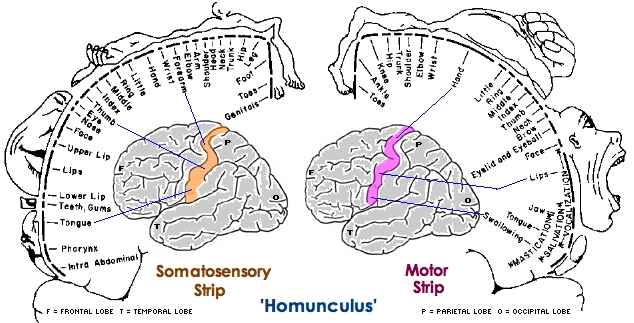
It all comes down to a part of the brain called the somatosensory cortex which processes all tactile sensations received from the skin. Sensory nerves from all of the skin have been mapped onto the somatosensory cortex, and this enabled us to create a fetching map of sensory input called Penfield Homunculi. Absence of sensory input from an arm for example does not mean that part of the somatosensory cortex is necessarily idle but continuously active, which is where the bizarre sensation of a phantom limb comes from.

The somatosensory complex tends to start reorganising itself directly after amputation and for several years after, to try and compensate for the loss of sensory input. Another patient of Ramachandran’s had a painful left phantom arm, and he discovered that when touched on the right side of his face he felt the sensation in his arm. They were able to map sensations for each of his fingers onto his face. The Penfield Homunculi shows the face representation is next to the hand representation, so it was concluded likely that when the cortex received no sensory input from the arm, the area of the cortex representing the face began to invade the hand region; creating the misplaced sensations in the phantom limb.

Considering the plastic nature of the brain as demonstrated here, it would be reasonable to say that in those who had a phantom limb which disappeared in time, their brain accepts the visual information of the limb not being there, and somatosensory complex reorganises itself to not have an area for the limb which is no longer there.

An article I wrote for the second issue of QM Sci.

Saturday, 4 February 2012

Love at First.. Sniff?


The smelling stimuli we pick up from each other plays a bigger role than we think. By attracting us to our most genetically different and  most compatible partners; it just proves there is a lot to be said for relationship “chemistry”.

We have all heard how pheromones secreted in our sweat can supposedly attract the opposite sex, and certain pheromones have been proven to alter levels of hormones in the recipient smeller. But studies have shown that we produce a different molecule, which rather than causing a hormonal change, plays a significant role in deciding how attractive and compatible you find a person.

The “chemistry” that attracts a lover, friend, or foe is something distinct to each individual and can be traced right down to your genes. It reaches beyond physical traits and personality, to subconsciously influence behaviour. These chemical signals that are in your sweat, tears and saliva are directly influenced by your immune system.

MHC molecules (major histocompatabiliy complexes) are important in identifying invaders in our bodies, such as viruses and bacteria. The range of MHC molecules varies from person to person and the larger the diversity of MHC genes, the better adapted the individual is to fighting off disease. These molecules have been shown to influence a person’s natural odour.

A study into mating preferences in humans by the biologist Claus Wedekind, had six males wear T-shirts for two consecutive nights, the odours of which were then rated by females in degrees of pleasantness. Men with MHC genes that differed most to the females scored much more attractive than those with similar gene ranges. In fact, scents from MHC-dissimilar men actually reminded the women of their current or past mates more than the MHC-similar men, suggesting the subconscious analysis of MHC genes in humans plays a large part in our partner choices. Studies have suggested men are less sensitive to smelling stimuli than women.

The way we respond to chemical signals differs depending on one’s sexual orientation; heterosexual and homosexual women respond differently to male sweat. Smell stimuli can also be a turn off; the scent of female tears has been proven to lower sexual arousal in men. 

 These olfactory signals that encourage mating between those with dissimilar genes is biology’s way of trying to mix up the human gene pool and produce more virile offspring. Parents with more diversity in their MHC genes would have offspring with stronger immune systems, who will therefore be better adapted to fight the pathogens the world throws at them. It also deters inbreeding and close family relations. Evolution has even taken it a step further, to the point that parents with MHC similar genes are more likely to lose a child in the early stages of pregnancy than another couple with MHC similar genes.

An article I wrote last year for QMessenger online.

Friday, 3 February 2012

QM Sci: January


The first science magazine at QMUL, created by students (one of which was me!). 

Friday, 6 January 2012

V. S. Ramachandran is such a rockstar

...of neuroscience that is. I am writing an article on his work on phantom limbs and mirror neurons for QM Sci magazine.
 
His TED talk on "The Neurons that shaped Civilisation"

Monday, 2 January 2012

Where is my Mind?

We are a long way from understanding the how the mind and the brain are related. The brain weighs just less than 1.5kg, contains about 100 billion neurons, and each neuron forms between 500 and 2,000 connections. So how does this mass of jelly generate thought?

Discussion on how thought arises can be traced as far back as Aristotle, and several theories have been formed to answer the question since, but none have yet been proved. Although there have been advancements in techniques for studying the brain, the validity of them for studying higher cognition is under dispute. While this question is a branch of philosophical psychology, considering the problem from a neuroscience perspective can shed light on the old problem. The "Mind- Body" problem is significant for every individual, as it asks how we came to have reasoning and emotions beyond that of other animals, and could define to what degree our introspections are a subjective view of the world. Some of the theories on the Mind-Body problem: 

Monism
The brain creates the mind in an absolute sense.
Dualism
Mind and brain matter are two completely different things.
Substance Dualism
Takes dualism a step further in stating the mind and brain are fundamentally different things such that the mind does not occupy the same physical space as the brain.
Property dualism
Even if the mind comes from the brain, the mind and subjective experience has properties that cannot be explained by the brain.

Substance Dualism, does not account for the Cartesian gap, which asks how an immaterial mind can affect the physical matter of the brain.  

The structure of the brain can be described on various levels of organisation: molecules, synapses, neurones, networks, maps, systems, central nervous system. In the past, psychology was studied by working backwards from behaviour, without reference to the inner mental states; a approach pioneered by B. F. Skinner. Reductionism is a way of examining systems from macro to micro levels, from behaviour right down to molecules. Only by conducting research at all levels and allowing the findings of each to influence the others will understanding of how the brain works be achieved (Churchland and Sejnowski, 1990). This is called intertheoretical reductionism.

Common sense understanding of reality is often misguided; for example the Earth appears flat to us even though it is in reality curved, and an object appears solid despite the fact that the atoms it is comprised of are mostly space. Science has proven our conceptions of the world to be misguided. In the same way, folk psychology argues that what we consider the mind to be is based upon our common sense understanding of how we view the world, and therefore is incorrect. Perhaps one day it will replaced by "eliminative materialism", a scientific explanation of the mind in terms of neuroscience. This makes the assumption that behaviour can be fully explained on a biological level, in the same way that other systems with our body can be explained by science. 

The many techniques scientists have developed for brain imaging can show us where activity is taking place in the brain, but not how. To this end, data can be used to support theories on how the brain works. However, some scientists have called neuroimaging the new phrenology (a pseudoscience that uses the morphology of the skull to understand the brain) since higher cognition or thought cannot be localised to brain regions, but are a culmination of various areas of the cortex.