Wednesday, 18 July 2012

Tuesday, 12 June 2012

Field Day 2012

This post is a little late. Field Day was on Saturday 2nd June, on "the most important weekend of our generation" according to Metronomy. Why they said that I don't not know. Because it was the diamond Jubilee weekend?(!) I hope not. Maybe because it marks the beginning of them making it big, which would make a bit more sense in terms of OUR generation.

For me it was a very important weekend because it was the first one after finishing my degree! I could finally BREATHE. Since then I have been busy with remembering what having a social life is like. Stand out bands for me were Friends, Metronomy and Beirut; the last of whom who I unfortunately didn't get any decent photos of.
FriendsFriends
Metronomy
Metronomy 

Thrifting

IMG_7672 IMG_7479 IMG_7476

What a babe

Kross Green Park  bike
Gradually cycling this across London back home, gone about 1/3 so far. Took me ages cause central is crowded and I especially hate cycling through big traffic on this bike. But the rest of the journey will be canals and parks, what this bike was made for; should be good.

Monday, 13 February 2012

The Curious Case of the Phantom Limb

After the unfortunate event of having a limb amputated two thirds of patients continue to feel the vivid sensation of a limb that is no longer there. 50-80% of patients experience incredibly painful burning, crushing or cramping in their phantom limb, leading many to depression and suicide. The phenomenon of a phantom limb is one that usually diminishes in time; but for some these phantom limbs stay present for years. Now a neuroscientist from San Diego has come up with a novel way of relieving people of their phantom.

V. S. Ramachandran’s first patient had his phantom arm for 11 years, before which his arm was in a paralysed and sling after one of the nerves was severed. After the amputation he had a phantom arm that was still chronically painful and he believed to be paralysed. Ramachandran placed him in front of a upright, side on mirror, and told him to place his left phantom arm behind the mirror and his right normal hand in front of the mirror. He wriggled his fingers on both hands and watched the reflection in the mirror. To his surprise he could see, and for the first time in 11 years, feel his phantom arm moving, and the pain was instantly reduced. After three weeks of daily practicing with this mirror box, his phantom arm disappeared and there was a remarkable reduction of pain.

The fact that sensations of paralysis and pain were perceived as being in the arm before and after the amputation is key to understanding what is going on here. Prior to the amputation the brain sent signals to move the arm, but it received back sensory input that the arm would not move. From this feedback the brain learnt the paralysis. So when the arm was amputated and the brain was not receiving any input from it, the brain assumed it was still paralysed.

However when in front of the mirror, the brain was receiving a flurry of new mixed messages about the arm: the muscle cells in his stump was telling the brain there was no arm, and in front of the mirror box his motor command and vision told him there suddenly was a fully functioning arm. Eventually the brain gave up on the arm, and learnt that it was just a phantom.

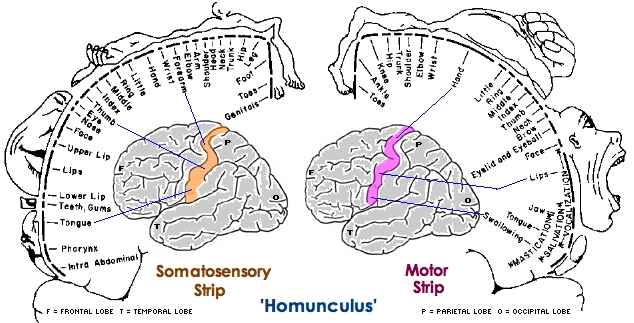
It all comes down to a part of the brain called the somatosensory cortex which processes all tactile sensations received from the skin. Sensory nerves from all of the skin have been mapped onto the somatosensory cortex, and this enabled us to create a fetching map of sensory input called Penfield Homunculi. Absence of sensory input from an arm for example does not mean that part of the somatosensory cortex is necessarily idle but continuously active, which is where the bizarre sensation of a phantom limb comes from.

The somatosensory complex tends to start reorganising itself directly after amputation and for several years after, to try and compensate for the loss of sensory input. Another patient of Ramachandran’s had a painful left phantom arm, and he discovered that when touched on the right side of his face he felt the sensation in his arm. They were able to map sensations for each of his fingers onto his face. The Penfield Homunculi shows the face representation is next to the hand representation, so it was concluded likely that when the cortex received no sensory input from the arm, the area of the cortex representing the face began to invade the hand region; creating the misplaced sensations in the phantom limb.

Considering the plastic nature of the brain as demonstrated here, it would be reasonable to say that in those who had a phantom limb which disappeared in time, their brain accepts the visual information of the limb not being there, and somatosensory complex reorganises itself to not have an area for the limb which is no longer there.

An article I wrote for the second issue of QM Sci.

Saturday, 4 February 2012

Low Tide

Found these photos from Summer '09.
Low Tide
Low TideLow Tide

Love at First.. Sniff?


The smelling stimuli we pick up from each other plays a bigger role than we think. By attracting us to our most genetically different and  most compatible partners; it just proves there is a lot to be said for relationship “chemistry”.

We have all heard how pheromones secreted in our sweat can supposedly attract the opposite sex, and certain pheromones have been proven to alter levels of hormones in the recipient smeller. But studies have shown that we produce a different molecule, which rather than causing a hormonal change, plays a significant role in deciding how attractive and compatible you find a person.

The “chemistry” that attracts a lover, friend, or foe is something distinct to each individual and can be traced right down to your genes. It reaches beyond physical traits and personality, to subconsciously influence behaviour. These chemical signals that are in your sweat, tears and saliva are directly influenced by your immune system.

MHC molecules (major histocompatabiliy complexes) are important in identifying invaders in our bodies, such as viruses and bacteria. The range of MHC molecules varies from person to person and the larger the diversity of MHC genes, the better adapted the individual is to fighting off disease. These molecules have been shown to influence a person’s natural odour.

A study into mating preferences in humans by the biologist Claus Wedekind, had six males wear T-shirts for two consecutive nights, the odours of which were then rated by females in degrees of pleasantness. Men with MHC genes that differed most to the females scored much more attractive than those with similar gene ranges. In fact, scents from MHC-dissimilar men actually reminded the women of their current or past mates more than the MHC-similar men, suggesting the subconscious analysis of MHC genes in humans plays a large part in our partner choices. Studies have suggested men are less sensitive to smelling stimuli than women.

The way we respond to chemical signals differs depending on one’s sexual orientation; heterosexual and homosexual women respond differently to male sweat. Smell stimuli can also be a turn off; the scent of female tears has been proven to lower sexual arousal in men. 

 These olfactory signals that encourage mating between those with dissimilar genes is biology’s way of trying to mix up the human gene pool and produce more virile offspring. Parents with more diversity in their MHC genes would have offspring with stronger immune systems, who will therefore be better adapted to fight the pathogens the world throws at them. It also deters inbreeding and close family relations. Evolution has even taken it a step further, to the point that parents with MHC similar genes are more likely to lose a child in the early stages of pregnancy than another couple with MHC similar genes.

An article I wrote last year for QMessenger online.

Friday, 3 February 2012

QM Sci: January


The first science magazine at QMUL, created by students (one of which was me!). 

Friday, 6 January 2012

V. S. Ramachandran is such a rockstar

...of neuroscience that is. I am writing an article on his work on phantom limbs and mirror neurons for QM Sci magazine.
 
His TED talk on "The Neurons that shaped Civilisation"

Monday, 2 January 2012

Where is my Mind?

We are a long way from understanding the how the mind and the brain are related. The brain weighs just less than 1.5kg, contains about 100 billion neurons, and each neuron forms between 500 and 2,000 connections. So how does this mass of jelly generate thought?

Discussion on how thought arises can be traced as far back as Aristotle, and several theories have been formed to answer the question since, but none have yet been proved. Although there have been advancements in techniques for studying the brain, the validity of them for studying higher cognition is under dispute. While this question is a branch of philosophical psychology, considering the problem from a neuroscience perspective can shed light on the old problem. The "Mind- Body" problem is significant for every individual, as it asks how we came to have reasoning and emotions beyond that of other animals, and could define to what degree our introspections are a subjective view of the world. Some of the theories on the Mind-Body problem: 

Monism
The brain creates the mind in an absolute sense.
Dualism
Mind and brain matter are two completely different things.
Substance Dualism
Takes dualism a step further in stating the mind and brain are fundamentally different things such that the mind does not occupy the same physical space as the brain.
Property dualism
Even if the mind comes from the brain, the mind and subjective experience has properties that cannot be explained by the brain.

Substance Dualism, does not account for the Cartesian gap, which asks how an immaterial mind can affect the physical matter of the brain.  

The structure of the brain can be described on various levels of organisation: molecules, synapses, neurones, networks, maps, systems, central nervous system. In the past, psychology was studied by working backwards from behaviour, without reference to the inner mental states; a approach pioneered by B. F. Skinner. Reductionism is a way of examining systems from macro to micro levels, from behaviour right down to molecules. Only by conducting research at all levels and allowing the findings of each to influence the others will understanding of how the brain works be achieved (Churchland and Sejnowski, 1990). This is called intertheoretical reductionism.

Common sense understanding of reality is often misguided; for example the Earth appears flat to us even though it is in reality curved, and an object appears solid despite the fact that the atoms it is comprised of are mostly space. Science has proven our conceptions of the world to be misguided. In the same way, folk psychology argues that what we consider the mind to be is based upon our common sense understanding of how we view the world, and therefore is incorrect. Perhaps one day it will replaced by "eliminative materialism", a scientific explanation of the mind in terms of neuroscience. This makes the assumption that behaviour can be fully explained on a biological level, in the same way that other systems with our body can be explained by science. 

The many techniques scientists have developed for brain imaging can show us where activity is taking place in the brain, but not how. To this end, data can be used to support theories on how the brain works. However, some scientists have called neuroimaging the new phrenology (a pseudoscience that uses the morphology of the skull to understand the brain) since higher cognition or thought cannot be localised to brain regions, but are a culmination of various areas of the cortex.